
27. A framework to help you write, scale and understand recipes, plus my go-to rough puff pastry recipe
This is my easy guide to baker's percentages. This is a long one, so make a cup of tea. It'll be worth it, I promise!

Hello!
Welcome to another edition of Roll With It. I hope you’re having a gorgeous month.
May started along The Jurassic Coast in Dorset. A long weekend of walks, beating sunshine, freezing cold tents, gas stove bacon sandwiches, staring at the stars, eating lots of biscuits, and maybe the best burger I’ve had. Ever. It was magical. Other highlights this month have included making a Louise cake (a sponge cake baked with a layer of rhubarb compote and a layer of meringue), accidentally stabbing myself in the hand with a large chef’s knife whilst slicing some slippery butter blocks and having to go to A&E, having my best pals from Ireland come to visit, putting crunchy things like tortilla chips on top of leaves and calling it ‘salad’, and enjoying the long, warm days outside whilst reading my book (Midnight Chicken by Ella Risbridger).


This newsletter we’re going to be making (in my opinion) the GOAT (greatest of all time); rough puff pastry. Rough puff pastry is the most versatile dough with the greatest of flakes. It’s easier than full puff pastry but has a little bit more oomph than regular pie dough. I’m also going to be sharing with you a little intro to baker’s percentages. Warning! Maths is not my strong suit. However, I hope my basic understanding will give you the foundation to do with it what you will. And if you don’t care about them at all (which is fair enough) jump to the rough puff pastry recipe below.
This all happens to coincide with a class I’m teaching at Pump Street in Suffolk. Where I will deep dive into all things pastry; the hows, the whats, the whys. With a particular focus on rough puff pastry. There are a few tickets left, so if you can make it, I’d love for you to join.
Much love,
Cissy…xo
Baker’s Percentages
In my last article (my guide to recipe testing) I very briefly touched on something called baker’s percentages. This is when you express all the ingredients of a recipe as a percentage of the total weight of flour (which always totals 100%).
Today we’re going to expand on this so that by the end of this article you’ll be able to use a baker’s percentage to make my rough puff pastry recipe your own. How? This will become clear.
Now, if you’re anything like me - completely useless at maths - then don’t be afraid! We are going to have to do a little bit of maths BUT we’re going to get a spreadsheet to do some of the heavy lifting for us. And, as this is a safe space, I want you to know that it probably took me six months to a year to grasp how the hell to use a baker’s percentage and sometimes I still have to reteach myself. So if you don’t get it, don’t worry! It’s not an essential tool for a home baker but it can make you feel like a badass.
Why use a baker’s percentages?
Using a baker’s percentage mostly helps us scale recipes, but it can also help us troubleshoot and make straightforward adjustments. It is most often used (but not limited to) the likes of sourdough, enriched doughs and pastry.
By expressing the ingredients of a recipe as proportional to the weight of flour, it helps us understand the recipe more by helping us hypothesise how each ingredient is going to work with the other. Particularly for things like dough hydration, consistency and fermentation. In this case, it does mean you have to have a little bit of knowledge on the science of baking to understand the hows and whys.
How do we use a baker’s percentage?
When working with a baker’s percentage we always value the weight of flour as 100% and the rest of the ingredients as a proportion to this. For example, if you use 50g water to 100g of flour, we would say the water has a baker’s percentage of 50%.
If you have the weight of each ingredient in a recipe and want to find out what the baker’s percentages are, you must first find out what 1% is. Working the other way, using percentages to find out the weights of ingredients, also requires you to start by finding what 1% is, but let’s save that for another time.
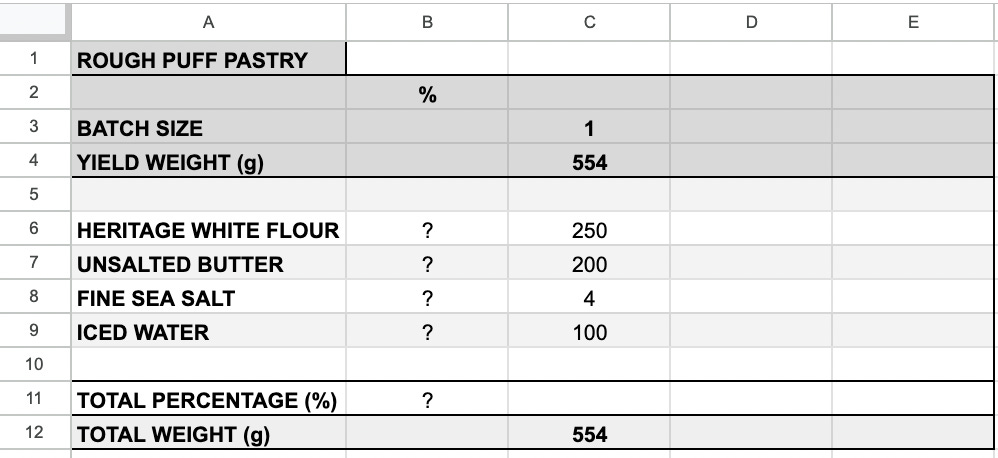
Using the recipe below, let’s work out the baker’s percentages.
Step by step guide
What is the total weight of each ingredient in grams? e.g. 554g
If we know the flour is always expressed as 100%, we know we can find out what 1% is, by dividing the total weight of flour by 100. e.g. 100 divided by 250 = 0.4
What is 1%? e.g. 0.4
To find the percentage of each ingredient, we multiply each ingredient weight by 1%. e.g. 200 x 0.4 = 80. Now we know the butter equals 80%.
Do this for all ingredients in the recipe. You should have something that looks like this…
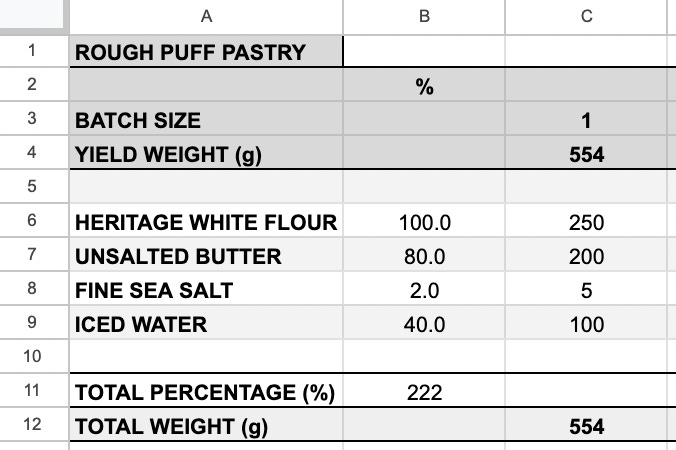
Now that we know what our baker's percentages are, it automatically tells us quite a lot about the recipe we’re working with, e.g. this recipe has a high percentage of butter. In any other recipe, we might think that 80% butter is quite high, but for rough puff pastry this is what we want. Butter helps create a rich flavoured dough as well as that signature crisp and flaky texture.
Having these percentages, also means we can easily scale and adjust the recipe. For example, we might test the recipe and find that it needs a little more salt, so we increase the salt from 2% to 2.5%. Or, we might want to make a larger batch size.
However, when we change a percentage or weight we need to make sure everything remains proportional, otherwise it can throw everything out of whack. Imagine you increased the percentage of flour but all the other ingredients stayed the same. The dough would have proportionally less butter, water and salt, which would lead to a very dry dough.
For me, the easiest way to make these kinds of adjustments is in a spreadsheet because, for the most part, it does the hard work for you. It’s hard for me to explain this in words, so I’ve added a screenshot in the hopes that you are all spreadsheet wizards who can figure it out. (Don’t be fooled by the $ sign, it’s a little trick that keeps the cells ‘locked’).
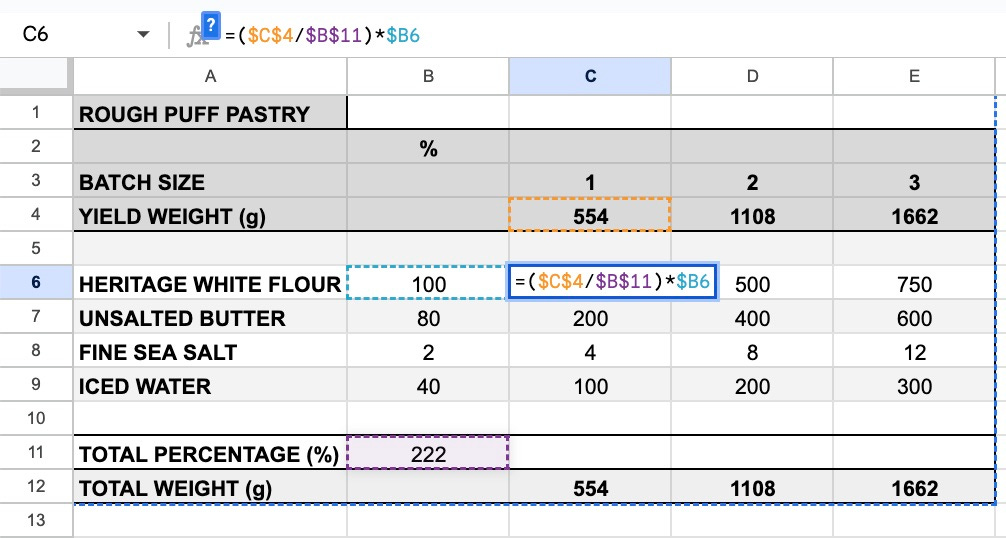
Once you have this up and running you can use it as a framework to write your own recipes or adapt existing ones. Ok that’s enough numbers for me for one day.
Rough Puff Pastry
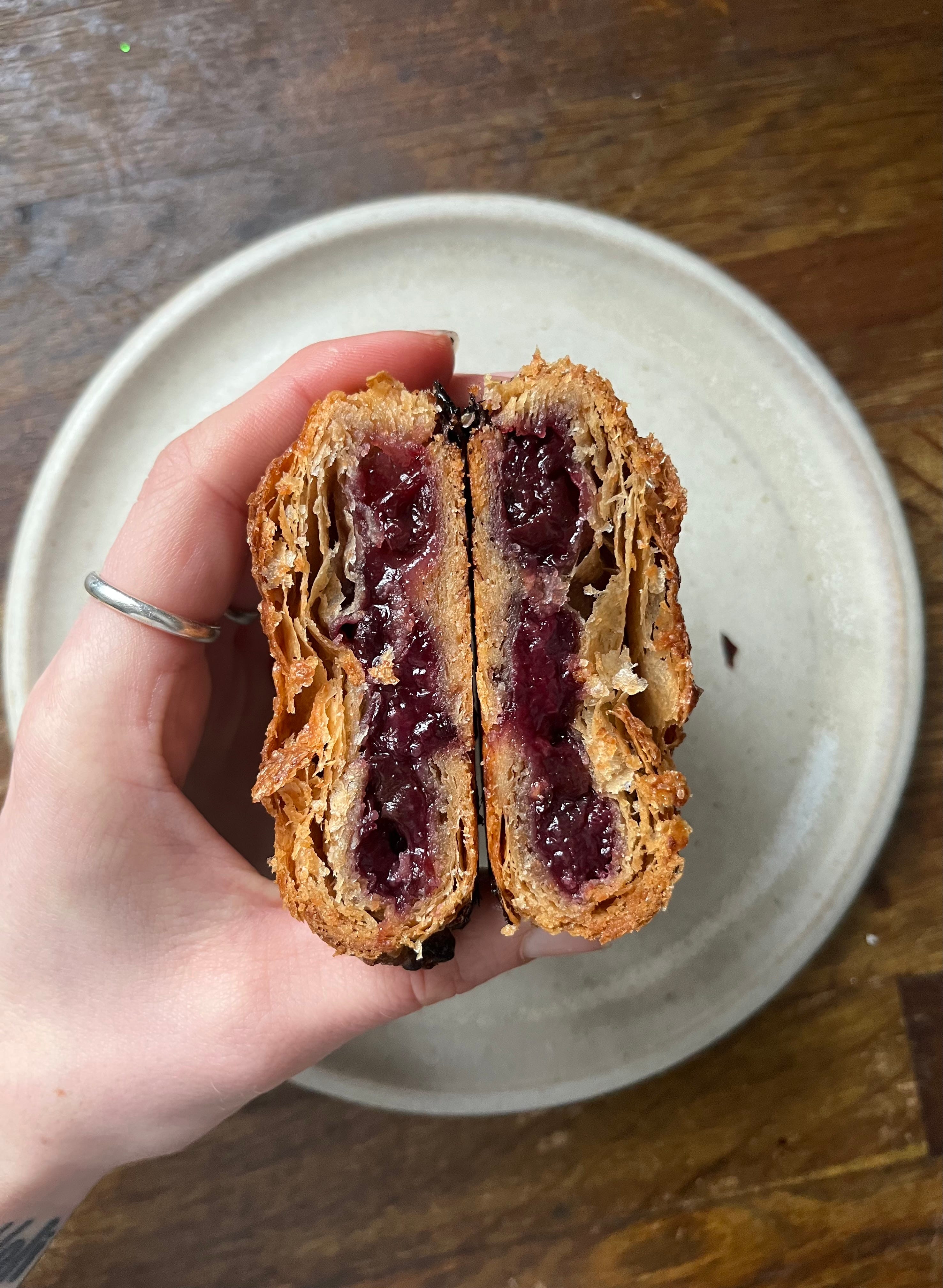
Rough puff pastry is one of my favourite pastries to work with, as although it is simple in ingredients it delivers in fuss-free elegance and a notorious flaky texture. With it you can make a whole range of things, such as hand pies, galettes, sausage rolls, turnovers and tarts. It is a foundation from which to build and get creative.


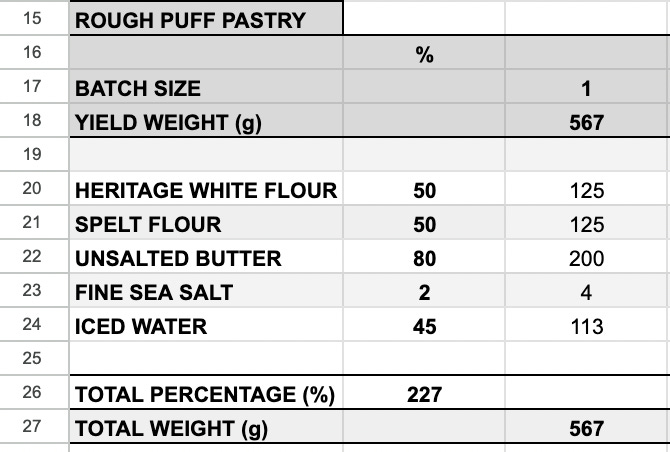
Using our baker’s percentage framework, we are going to change the above rough puff pastry recipe to include a percentage of spelt flour. If you would prefer not to use any spelt, you can omit it completely and just use 100% plain flour (I use a heritage white flour from Landrace Milling).
How do you get the dough to be so flaky?
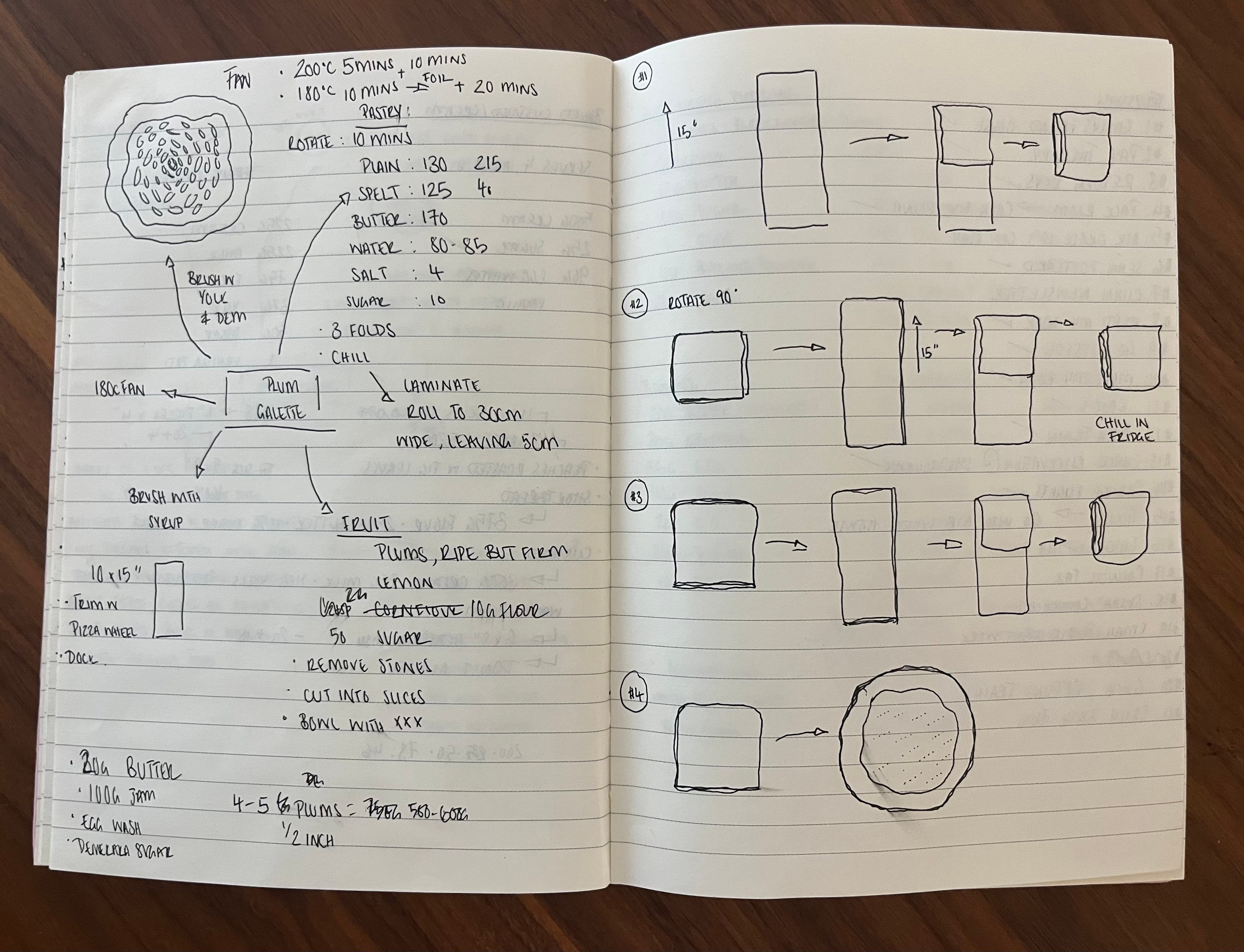
Rough puff pastry is made up of only a few ingredients. The key to its flaky texture is a technique called lamination. This is the process of rolling out dough, then folding it up and then repeating it all over again until you have lots and lots of layers.
For this recipe we will be giving the dough three ‘letter folds’ (also known as single folds). Which is when you fold the dough into three equal pieces, then fold it like you would when putting a letter inside an envelope.
Please bear with me! I know it sounds complicated but it’s actually really simple and totally worth it for the results. Also, having this technique in your back pocket is an amazing starting point, in case you want to learn more complex doughs like puff pastry, invert puff pastry or croissant dough.
Rough Puff Pastry Recipe
Ingredients
125g plain flour
125g spelt flour
200g unsalted butter, cold, sliced
4g fine sea salt
110-30 ml iced water (+/-)
Method
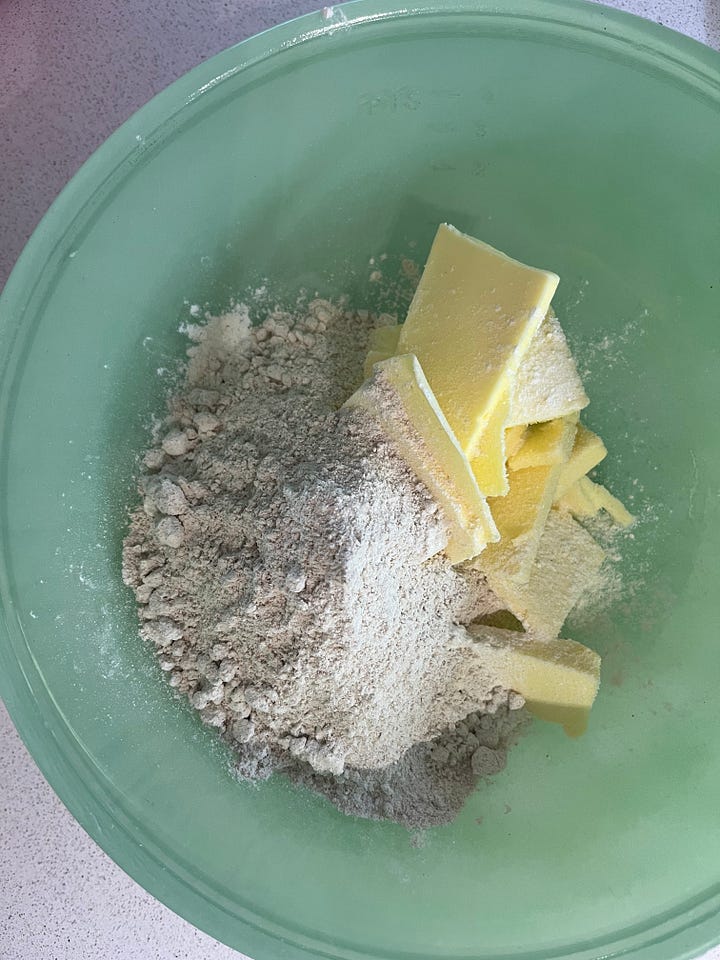
In a large bowl combine the flours, salt and cold sliced butter.
Gently mix the butter into the dries, handling it as little as possible and keeping the butter flakes large.
Add in 100ml iced water in stages, gently mixing after each addition until it looks hydrated. If the dough is looking dry, add in the reserved 30g water. Airing on the side of caution is key here, as you can always add more water but you can’t take it back. You’re looking for a slightly shaggy dough that comes together by hand, not a tacky, soupy, wet dough. Some flours are ‘thirstier’ than others so will take more water, whilst others won’t. Use your baker’s intuition.
Once the dough has come together, form into a small rectangle, around 1-2 inches high. Wrap in baking parchment and transfer to the fridge to chill whilst you do some washing up and grab a cup of tea.
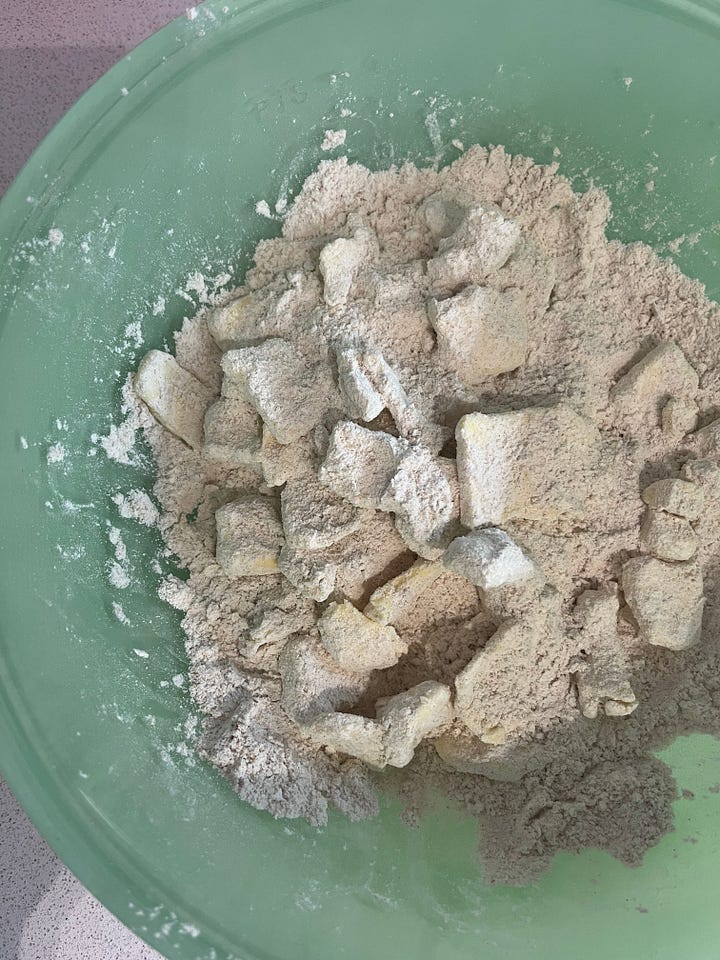
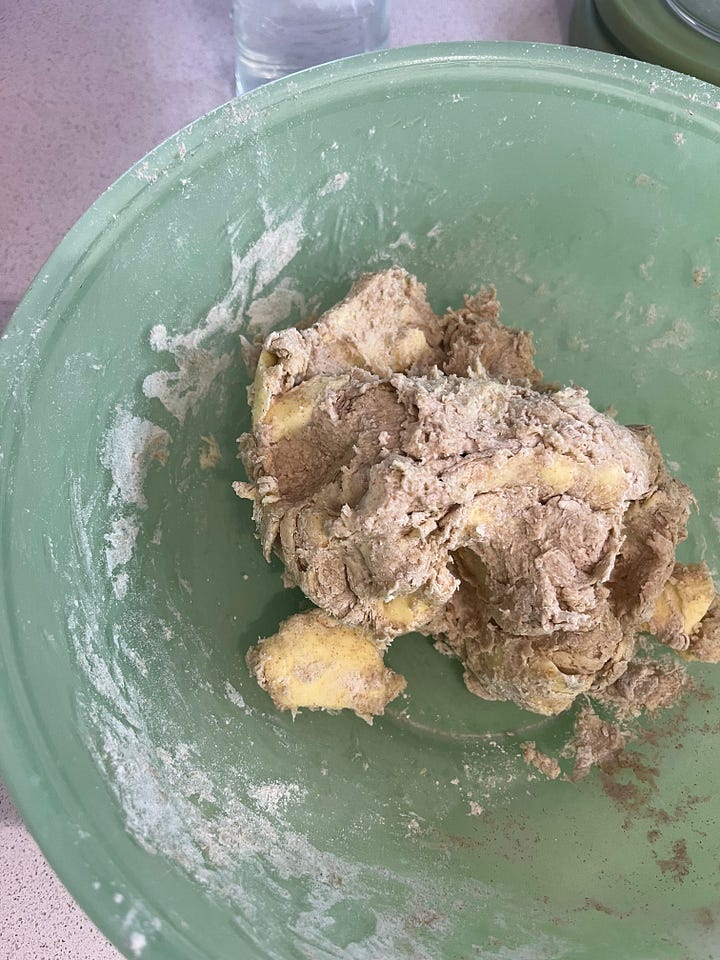
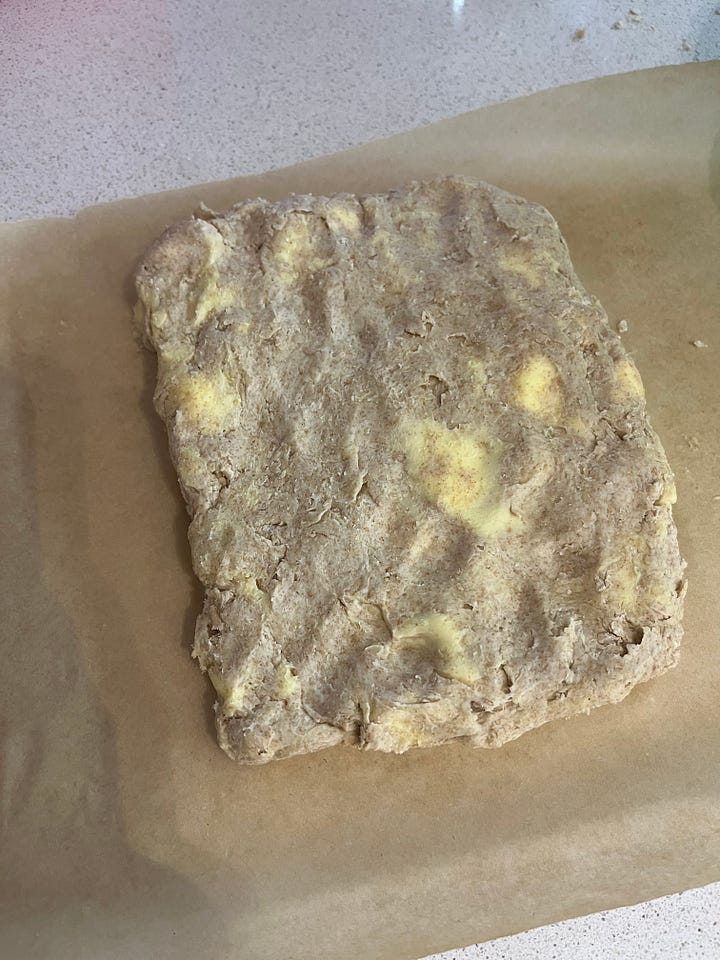
Mixing rough puff pastry Around 30 minutes later, remove the dough from the fridge. We will now be laminating our dough by performing a series of folds.
Turn the dough out onto a work surface lightly dusted with flour.
Using a rolling pin, roll the dough out into a long rectangle (roughly 15 x 7 inches). Flour the dough as needed, to prevent it getting stuck to the workbench.
Now fold the sheet of dough into three, like a letter.


Repeat the above rolling and folding steps once more, before wrapping the dough in parchment and refrigerating for 30 minutes to 1 hour.
Once the dough has chilled, remove from the fridge and repeat the above rolling and folding steps.
You have now made a total of 3 letter folds. (Yay, go you!).
Wrap your beautifully laminated pastry in parchment and refrigerate for 1 hour (but preferably overnight) before using. Alternatively, the pastry will keep well tightly wrapped in the fridge for 3 days or in the freezer for 1 month.
I’ve worked as a pastry chef for over 12 years and never really understood bakers percentages until now so thank you for this. I’m just not a maths girl