
54. The Wheat Fields
how an afternoon learning about wheat unlocked forgotten memories

The sun beat down fiercely on the ochre fields, gilding them in gold. The stone farmhouse with its impressive corbelled stair turret and embattled tower, paired with the dry, heavy heat, felt more like the South of France than a farm nestled beneath the Quantocks.
We’d come to visit Gothelney Farm, where almost all of the grain we use in the bakery is grown and milled.
In an attempt to escape the heat of the afternoon, we sheltered beneath an avenue of trees that dappled spots onto a nearby pig that lay panting on its side. Here we fell into a deep discussion about the landscape of British flour and the Rye and Mariagertoba that grew beside us. Fred spoke, as ever, with his infectious enthusiasm. A man committed to loving our biosphere. Every so often reality seemed to interrupt him. The list of jobs that needed to be ticked off before the imminent harvest, the school run, and getting the farm out of generational debt. It seems farming requires you to hold both hope and uncertainty at the same time.
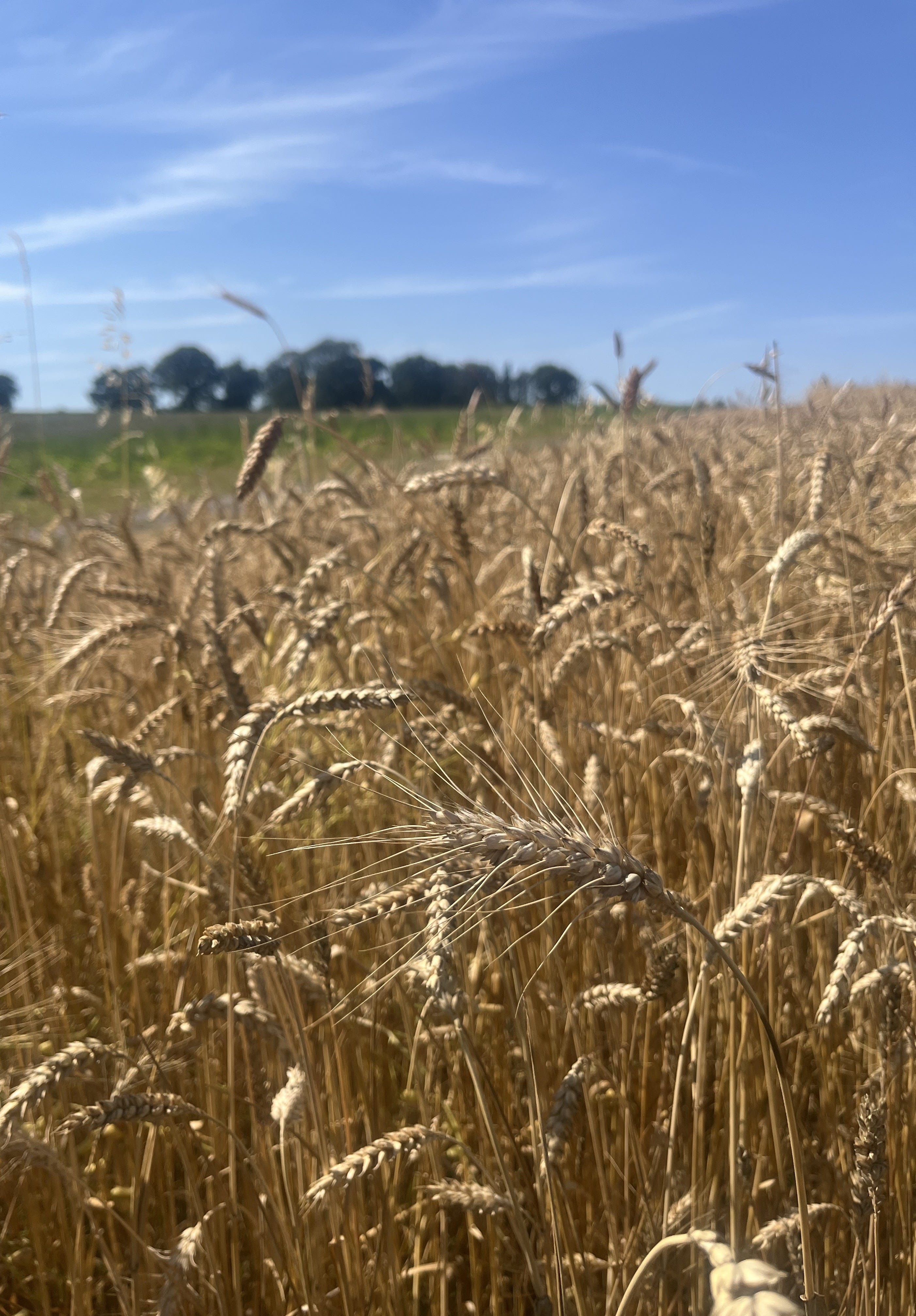
We continued our conversation while weaving through the fields to the trial plots, where stalks vary in height and some heads are hairier than others. Little scratches on my bare arms and legs appear scorched into my skin.
These scratches are familiar ones.
They’re the same scratches I’d come home with after wandering through the wheat fields that bordered our family home when I was growing up. At this time of year, I’d be doing the same thing as I am now, brushing up against the wheat, ambling along the path carved out by the thick tyre marks of the tractors that upturned the dried earth. Listening to the swishing in the wind and feeling the sap of sticky weed staining my legs.
My sister and I would often stay out here for hours, making up dance routines, exploring the woods, and walking down to the river until the light dipped and turned a majestic honey colour.
When the harvest came, we were forced out of the fields, left to watch the tractors and combine harvesters thunder up the roads, leaving giant plumes of dust behind them. For a few summers, Mum managed to convince the farmers to let us ride with them in their cabs. Up there, the wheat looked like grass. Short, small and easily flattened. I could comfortably stand inside the hub of a tractor wheel. So inside the cab, I gripped onto the bar that ran along the side of the glass door. A little fearful of the slow, loud and methodical work being done.
The rides felt like they might last forever, but we were always called back inside for tea.
Afterwards, I’d watch from my bedroom window, where for twelve years I’d seen the fields change with the seasons. Muddy, damp, and full of potatoes, to swathes of bold, lemon-yellow rapeseed.
On some summer evenings, when the fields were now stubbled from their shave, I’d sometimes spot a hot-air balloon float over the Romney Marsh. They looked like giant coloured light bulbs, each injection of flame illuminating the fabric before it carried on.
Occasionally the bulbs would grow larger and larger on the horizon as they drifted closer to the house. Sometimes landing in the nearest field. When this happened, I’d drop my CDs or ‘my scene’ dolls and rush out to inspect it, bringing everyone in tow, as if it were some sort of extraterrestrial sighting.
To this day, Mum always complains I hated the outdoors. But those fields felt like my safe place. When I was in trouble, or felt misunderstood I would pack a bag with some treasured possessions - a book, some biscuits and my Horsey Horsey, and wrap myself impractically in my crisp white dressing gown, sneak out the back door, and rush into the wheat, where I’d crouch down and stare up at the clouds, hoping no one could see me. I’d roll a sheaf between my fingers, threshing the kernel from the chaff to inspect it, just like Fred does. I’d wait for the loud echoing calls of my Mum and Sister, who shouted my name with anger and a slight tinge of fear.
I always wanted to be found.
“Running away” never lasted more than half an hour, before Mum sentenced me to bed without dinner. In those short moments though, between escape and being found, I felt lost in a hidden world.
All these years later, I spend days surrounded by flour, rarely thinking about the past at all. But with one brush of grain and the heat of summer, somehow I found my way back.
A note…
Gothelney Farm is a family-run farm in Somerset, where much of the grain we use at Coombeshead Farm is grown and milled. Last year, I wrote about the farm and Fred’s work for Ómós Digest. If you’re curious to learn more about why it’s such a special place, you can read the piece here.
If you’d like a glimpse into what happens to that grain once it reaches the bakery, my friend Jacob McCarthy wrote a lovely piece about the bread-making process at Coombeshead Farm, which you can read here. Jacob is now the resident chef at 101 Bridport in Dorset, if you’re nearby, I recommend booking yourself a table.
Beautiful writing. I also grew up next to wheat fields and often used to back a bag and run away from home for a few hours. I’ll never forget the scale when it all seemed so vast and to tower above me. The scratching once it became stubble always tore my legs to shreds!